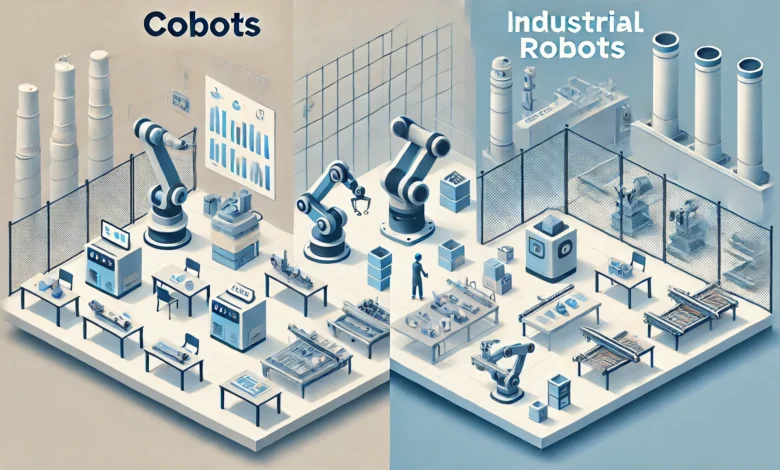
Cobots vs industrial robots is a critical comparison for manufacturers deciding how to automate their operations. Both technologies are designed to increase productivity, improve consistency, and reduce operational costs, but they serve very different roles on the factory floor. In simple terms, industrial robots are built for high-speed, high-volume automation with minimal human interaction, while collaborative robots, or cobots, are designed to work safely alongside people. Understanding these differences helps manufacturers choose the right solution for their production goals, workforce, and budget.
What Are Industrial Robots?
Industrial robots are automated machines designed to perform repetitive, high-precision tasks at high speed. They are commonly used in applications such as welding, painting, palletizing, material handling, and assembly.
These robots typically operate inside fenced or enclosed areas to protect workers from moving parts. Once programmed, industrial robots perform the same tasks continuously with minimal variation.
Industrial robots are best suited for environments where production volumes are high, tasks are standardized, and human interaction during operation is limited or unnecessary.
What Are Collaborative Robots (Cobots)?
Collaborative robots, commonly called cobots, are designed to work safely in close proximity to humans. Unlike traditional industrial robots, cobots are equipped with sensors, force limits, and safety features that allow them to stop or slow down when they detect human contact.
Cobots are typically smaller, lighter, and easier to program. Many can be set up using intuitive interfaces, hand-guiding, or simple software tools.
The primary purpose of cobots is to assist workers rather than replace them, making them ideal for tasks that benefit from human judgment combined with robotic precision.
The Fundamental Difference Between Cobots and Industrial Robots
The core difference lies in how they interact with people.
Industrial robots are designed for speed and power, which makes direct human interaction unsafe during operation. Safety is achieved through physical barriers and strict procedures.
Cobots prioritize safety and flexibility. They are designed to share workspaces with humans and adapt to changing tasks.
In short, industrial robots maximize output, while cobots maximize collaboration.
Typical Applications of Industrial Robots
Industrial robots are widely used in automotive manufacturing, electronics, metal fabrication, and high-volume consumer goods production.
They excel in tasks such as robotic welding, high-speed pick-and-place, automated painting, and heavy material handling.
These robots deliver consistent performance over long production runs and are ideal for environments where processes rarely change.
Typical Applications of Cobots
Cobots are commonly used in assembly, packaging, quality inspection, machine tending, and light material handling.
They are especially useful in small to medium-sized manufacturing environments where tasks change frequently and full automation may not be practical.
Cobots are also popular in operations where labor shortages exist or where workers need ergonomic assistance.
Ease of Programming and Deployment
Industrial robots usually require specialized programming skills and longer setup times. Changes to tasks or layouts can involve significant reprogramming and downtime.
Cobots are designed for ease of use. Many can be programmed by shop-floor staff with minimal training.
This ease of deployment makes cobots attractive for manufacturers who need flexibility and fast return on investment.
Safety Considerations
Industrial robots rely on physical safety measures such as cages, light curtains, and interlocks to protect workers.
Cobots use built-in safety features including force-limiting joints, speed monitoring, and collision detection.
While cobots are safer for shared environments, risk assessments are still required to ensure safe operation.
Cost and Investment Comparison
Industrial robots often require higher upfront investment. Costs include the robot itself, safety infrastructure, integration, and programming.
Cobots typically have lower initial costs and reduced installation expenses. They also require less floor space and minimal safety fencing.
However, industrial robots may offer lower cost per unit in high-volume production due to faster cycle times.
Productivity and Performance
Industrial robots deliver maximum throughput and precision. They are optimized for speed and can operate continuously with minimal variation.
Cobots operate at slower speeds to ensure safety, which can limit throughput.
The trade-off is flexibility. Cobots adapt quickly to new tasks, while industrial robots excel at repetitive work.
Workforce Impact
Industrial robots often replace manual labor in hazardous or repetitive tasks.
Cobots are designed to support workers by handling repetitive or physically demanding activities.
Many manufacturers use cobots to upskill employees, shifting them from manual tasks to supervision and quality roles.
Cobots vs Industrial Robots: Side-by-Side Comparison
| Aspect | Industrial Robots | Cobots |
|---|---|---|
| Human Interaction | Minimal, separated by safety barriers | Designed to work alongside humans |
| Speed and Power | High | Moderate and safety-limited |
| Programming Complexity | High | Low to moderate |
| Flexibility | Low | High |
| Best Use Case | High-volume, repetitive tasks | Variable, human-assisted tasks |
Pros and Cons of Industrial Robots
Pros:
High speed, precision, durability, and suitability for large-scale production.
Cons:
High cost, complex setup, limited flexibility, and strict safety requirements.
Pros and Cons of Cobots
Pros:
Safe collaboration, ease of use, lower cost, flexibility, and fast deployment.
Cons:
Lower speed, limited payload capacity, and not ideal for heavy-duty tasks.
How to Choose Between Cobots and Industrial Robots
Manufacturers should evaluate production volume, task complexity, and variability.
If speed and consistency are critical, industrial robots are often the better choice.
If flexibility, worker collaboration, and quick deployment are priorities, cobots are more suitable.
Many manufacturers adopt a hybrid approach, using both technologies where they fit best.
Frequently Asked Questions
Can cobots replace industrial robots?
No. Cobots complement industrial robots but do not replace them in high-speed or heavy-duty applications.
Are cobots safe without fences?
Yes, when properly risk-assessed and configured, but safety evaluation is always required.
Which is better for small manufacturers?
Cobots are often better for small and mid-sized manufacturers due to cost and flexibility.
Do industrial robots require skilled operators?
Yes. Programming and maintenance typically require specialized expertise.
Conclusion: Cobots vs Industrial Robots
Cobots and industrial robots serve different purposes in modern manufacturing. Industrial robots deliver speed and efficiency for large-scale, repetitive production, while cobots offer flexibility and safe collaboration in dynamic environments.
Choosing the right technology depends on production goals, workforce needs, and long-term strategy.
For many manufacturers, the most effective approach is not choosing one over the other, but combining both to build a balanced, future-ready automation strategy.